Coop
My contribution
Product and Service Designer, conducted interviews, created research artifacts, visuals and promotional materials.
Design response
A speculative hybrid service: caregivers could check availability and reserve workspace and childcare before arriving, then sign in at a kiosk.
- ROLE
- UX/UI designer
- Time Frame:
- Sept-December 2020
- Team:
- Selina Che, Nathaniel Gray
Skills: User Research, Product Design, UI/UX Design, Usability Testing, Storyboarding
Problem
The pandemic has put immeasurable pressure on caretakers
Solution
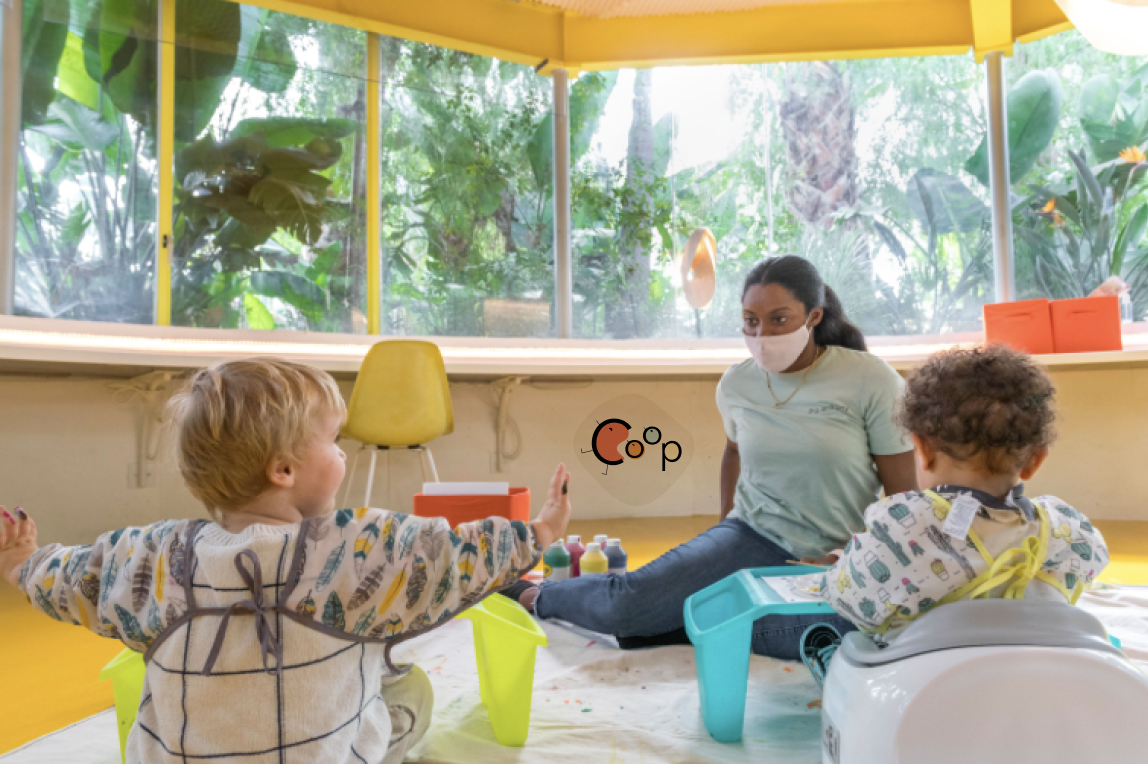
Coop provides a space for work and for play.
Phase 1: Discovery
Interviews and a diary study challenged our assumption that work and caregiving should be completely separate. We focused on guardians who wanted retraining opportunities and safe childcare, especially in low-access areas.
Read the interviews, diary study, and research findings

Explore
After some brainstorming for a problem space, we centered on parents juggling work and childcare responsibilities.
As child-free adults ourselves, we prioritized gathering the insight of local parents. We conducted initial interviews and created a diary study.
Research

This diary study showed the complexity of this sphere.
There were no simple answers and there were many shifting responsibilities and varied emotions that occur on any varied day.

Many families we talked to noted that while this was a challenging time, it was also great to have those spontaneous moments together throughout the day.
Our team originally hypothesized that a full division between professional and caregiving spaces would be ideal, but the diary study and interviews revealed that this wasn’t always possible, nor was it desirable for many families.

When we went to present our findings on this problem space, stakeholders bristled at the “productivity” framing and said that parents shouldn’t have to do more during this time.
We were surprised that our research was coming off as a capitalist guilt trip, as many of our study participants who worked multiple jobs saw retraining and investing in careers as a way to secure more work-life balance or safer work conditions.
To amend this, we would need to clarify our target audience and really underscore how this product/service would help the end user reach their goals.
Narrowing our Scope

While we sent our initial request to interview any local parents of grade school-age children, we ended up talking almost exclusively to moms and female guardians.
Guardians who were early in their careers or who held multiple jobs expressed interest in retraining for higher-paying, more flexible work. They linked retraining with less stress, more sleep, and more time spent with their kids.
We decided to focus our product specifically on the needs of guardians in low-access, especially rural areas who identify retraining as an avenue for reduced stress, and need safe childcare options while they pursue their goals.
This service will purposefully create a space for like-minded families to share ideas, resources and strengthen community ties.
Research Summary
1. Identifying the user is crucial for stakeholders to understand the use case and why this is a viable, desired service.
Our users valued time spent with their kids and wanted more of it.
2. Our product should be hybrid and not dependent on owning a desktop computer.
3. Our users may have a smartphone, but they need not have a desktop computer, tablet, or other electronics to access this service.
4. Our online and in-person services must be safe to use. As we are especially focused on the needs of women and children, both the online interface and the physical structure should be made safe for work and play.
5. For this reason, we must require a background check and identity verification before members of the public are able to access the locked physical space.
Phase 2: Design
We combined a physical space with mobile reservations and kiosk check-in. Families could check availability before traveling, while access would not depend on owning a desktop computer.
Ideate
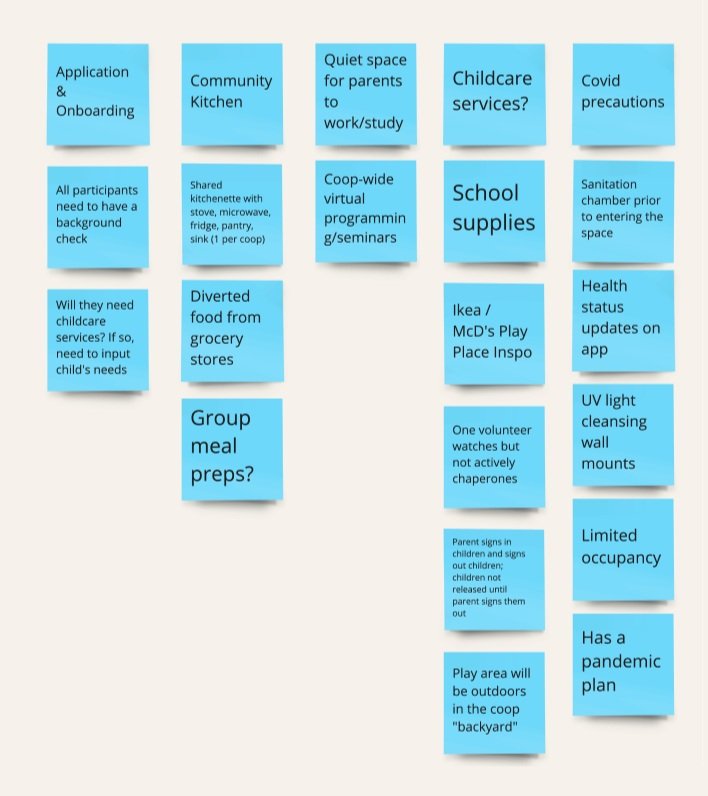
Each member of our three-person team generated 20 solutions to our identified problem. We then reconvened and grouped similar concepts together.
First, we downselected based on which ideas would be feasible in a real-world situation.
Next, we used our identified user values to take out any of the feasible ideas that wouldn’t best serve our specific audience group.
We then identified complementary concepts that may result in an ideal compound service.
Story and User Flow
Below you can see the different parts of this compound product. A user can check space ahead of time before they pack everything up and drive out to the location. When the user arrives, they can easily check themselves and their kids in for a workstation and or childcare services.
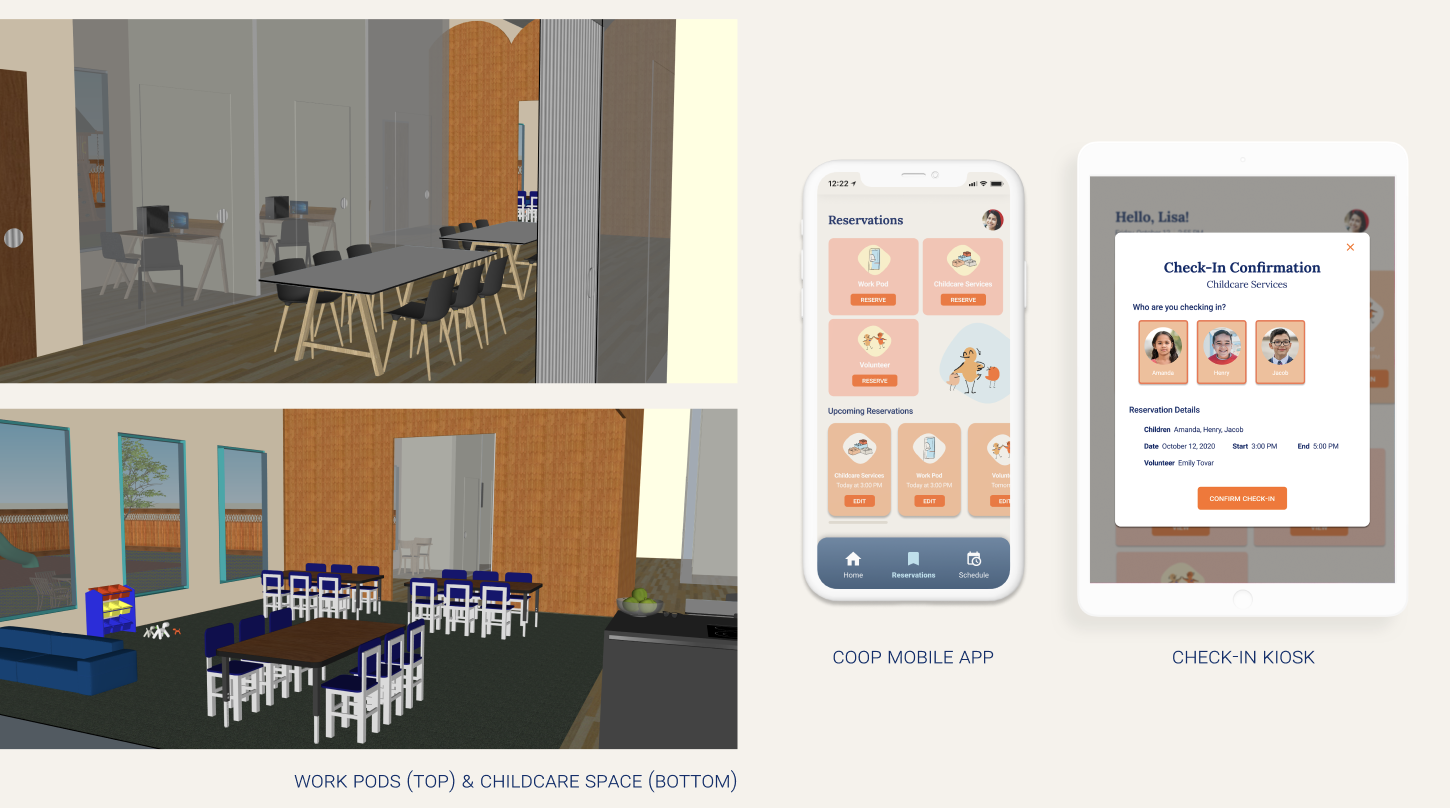
(Upper Left) Work Pods, (Bottom Left) Childcare Space (Right) Coop Mobile and Checkin Kiosk
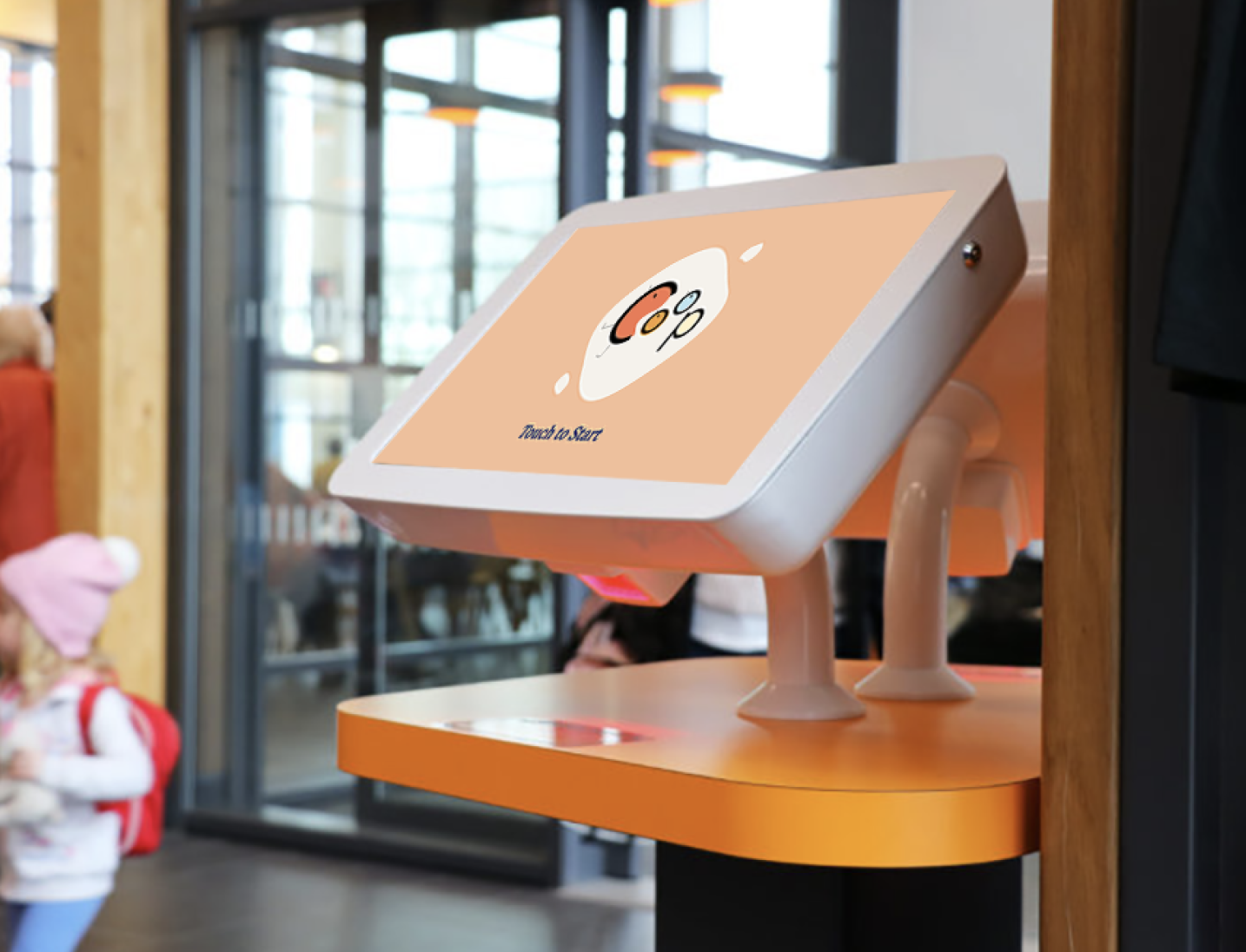
Coop Check in Kiosk
Discovery of Product and App Flow
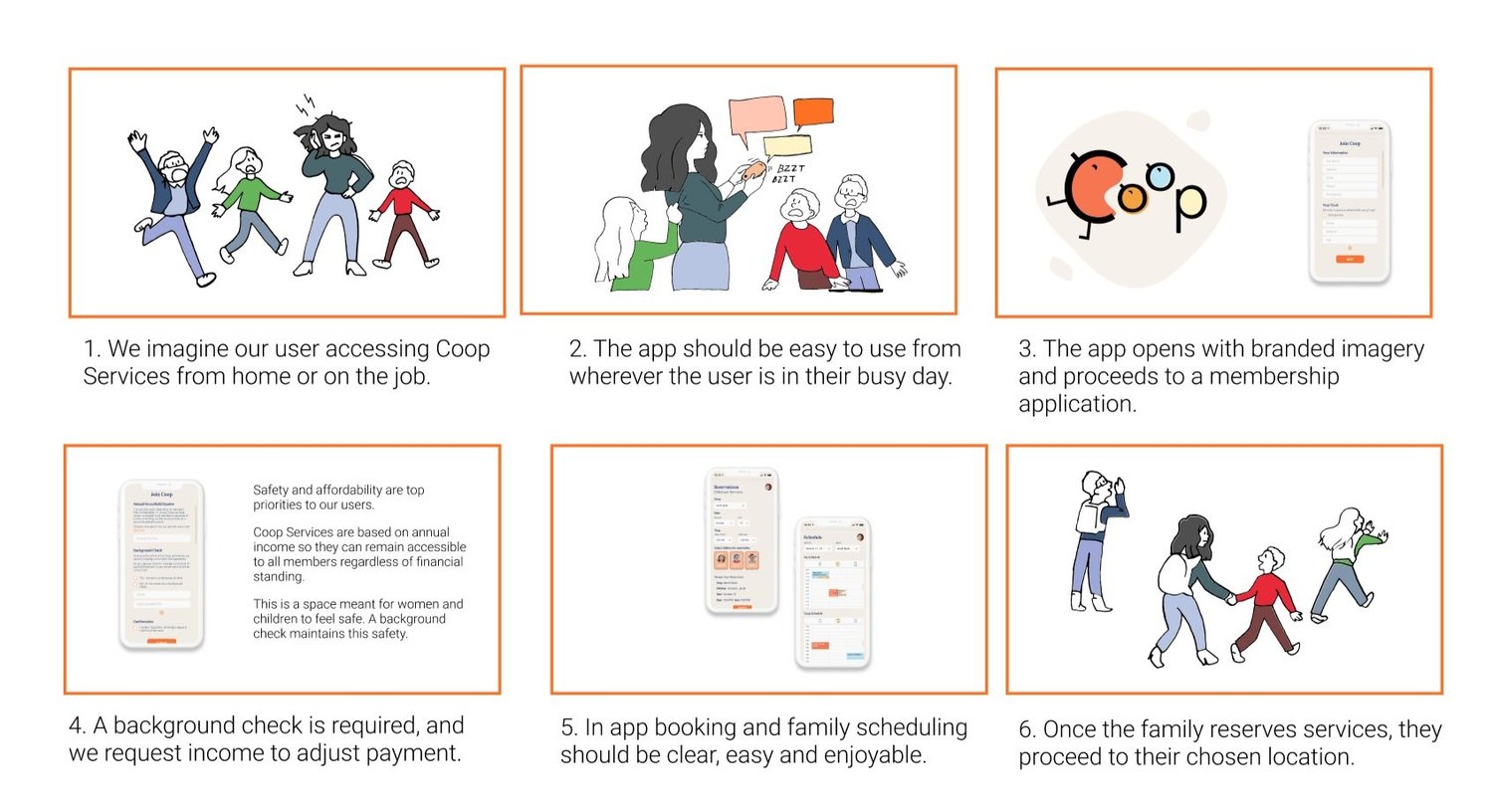
Key Path: User can reserve space before leaving home by using the app
Arrival and Kiosk Check-In
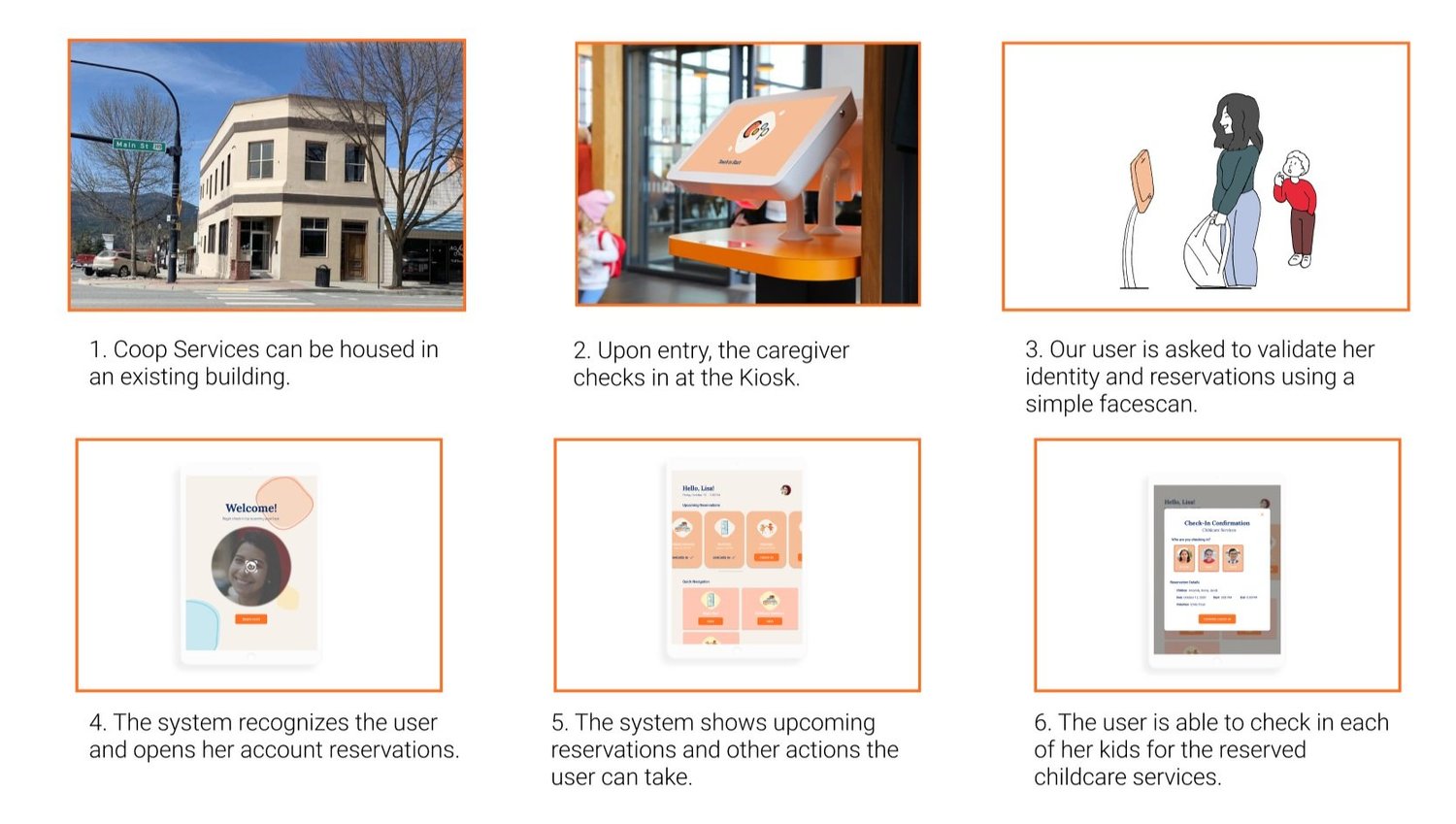
Arrival and Kiosk Check in
Physical Amenities
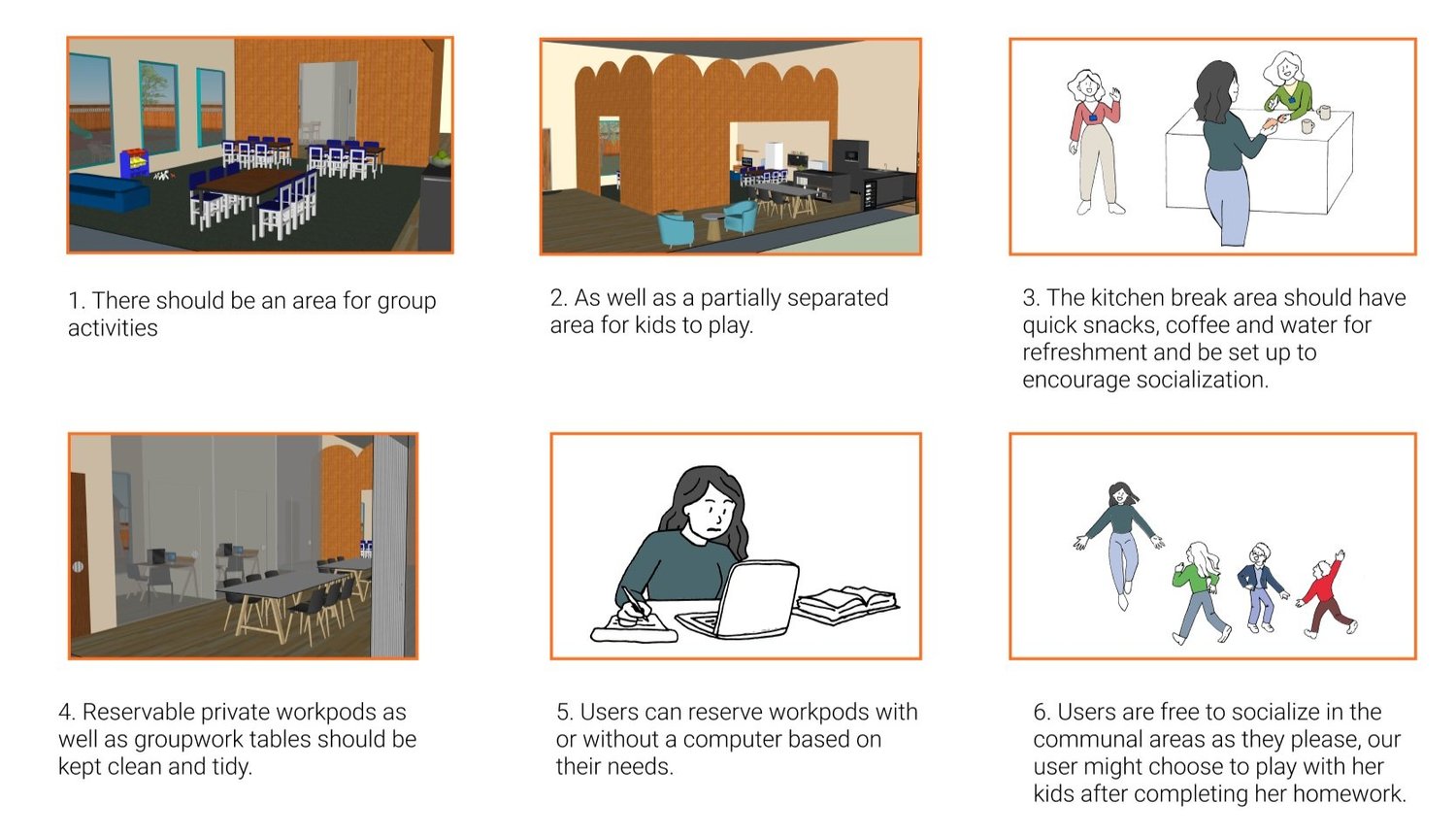
Physical Amenities
Mobile Wireframing
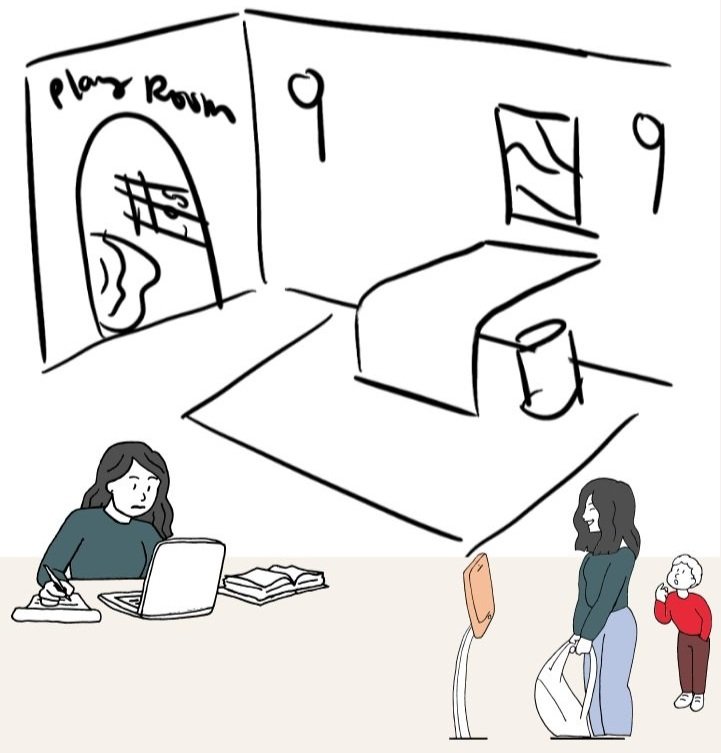
Early Concepts
Lo-Fi early concepts
The concept started out with a few drawings of different rooms and different uses for the space. We had a lot of different ideas to allow adults to do individual and group work, or even take calls in individual pods. We explored varied configurations to allow kids to play without disturbing professional work.
Our initial concept became pretty sprawling with a kitchen, a sanitizing station at the entrance, and unique areas for different types of work.
Mid-Fi Mobile Concepts
This was the setup for our hybrid reservation system. This app would allow guardians to fill out their profile and the profile of their children, as well as check availability and reserve a spot before arriving at the location.
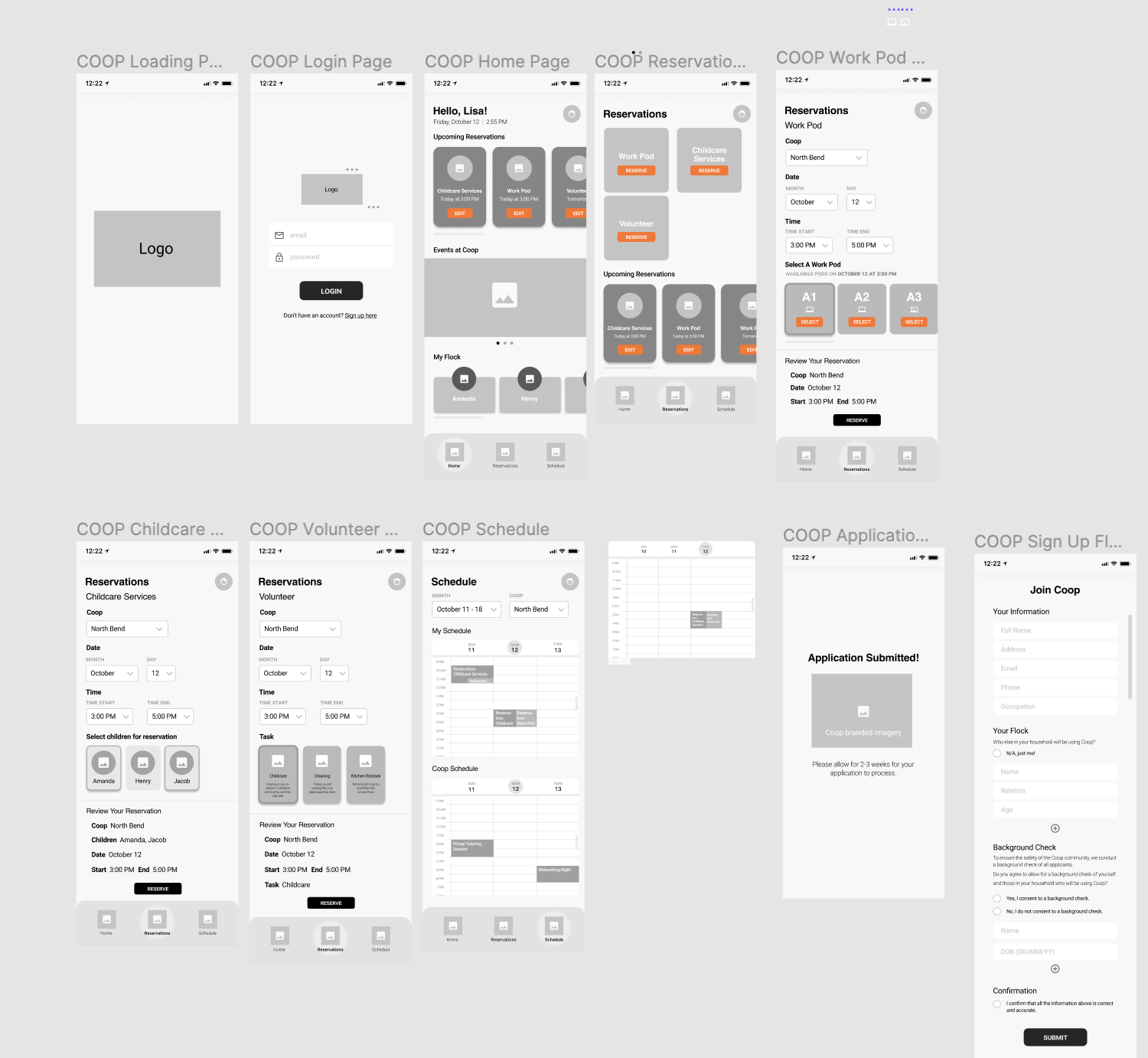
Mid-Fi Mobile Concept
Hi-Fi Mobile Wireframing
We then added some UI features and further functionality to the app. It was made to be incorporated with the sign in kiosk.
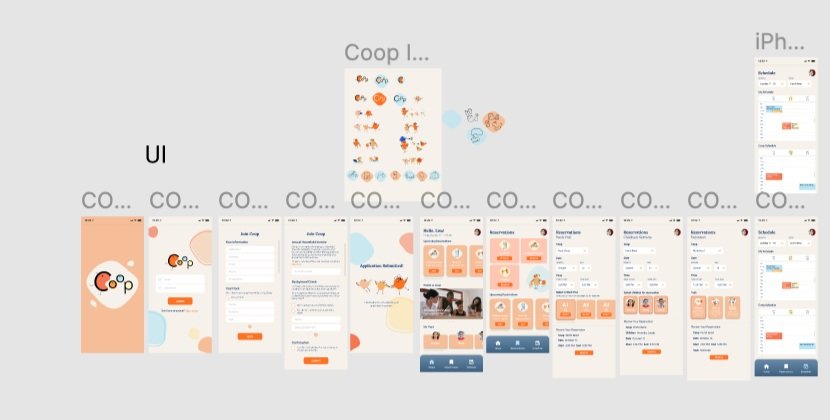
Hi-fi Mobile Wireframing
Mid-Fi Kiosk Wireframing
When the user arrives at the physical location, will then sign in at the check-in kiosk.
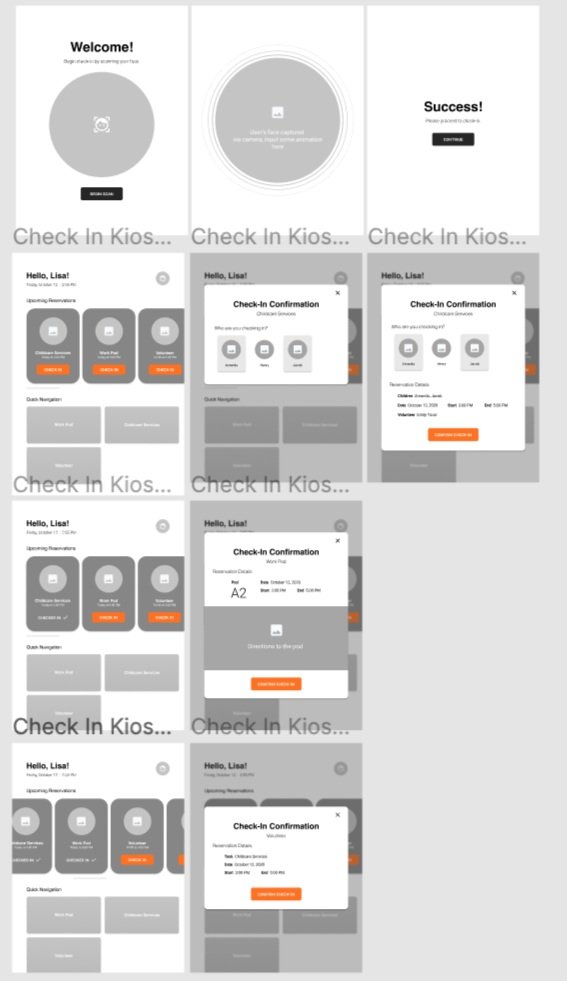
Kiosk Wireframing
Hi-Fi Kiosk Wireframing
We then added further fidelity to the kiosk setup and applied the new floorplan to the reservation system.
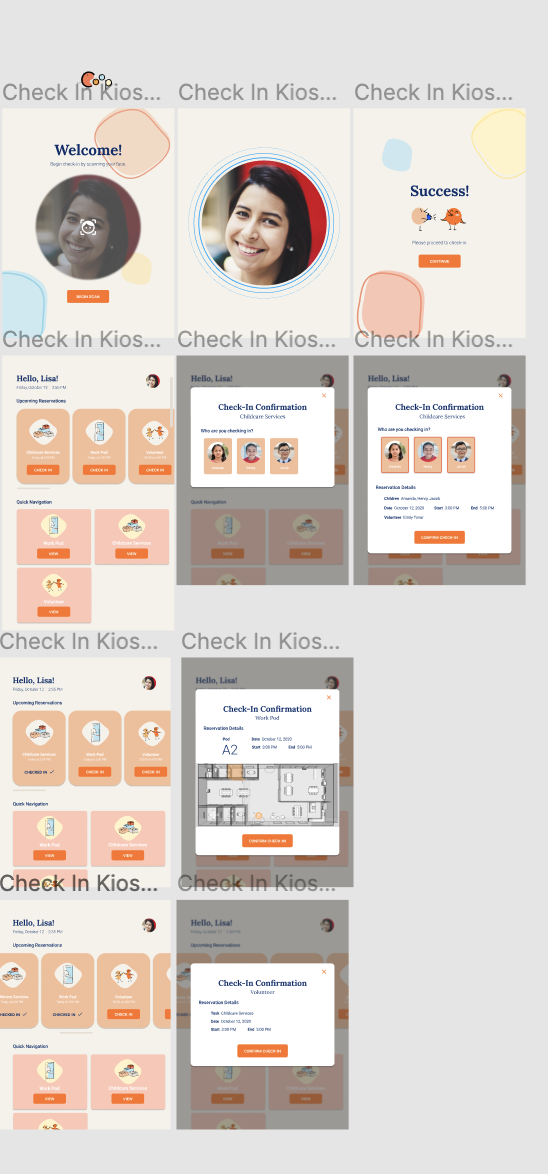
Kiosk Flow
For the physical building, we decided a 3D render would be the best way to conceptualize the service. In addition to the features inside the building, a 3D render would allow us to show potential use cases for outdoor space and how it might sit in a community.
The render was based on the barest possible setup, a standard rectangular unit. In its true conceptualization, however, COOP would be modulated to work in an existing empty structure within the community.
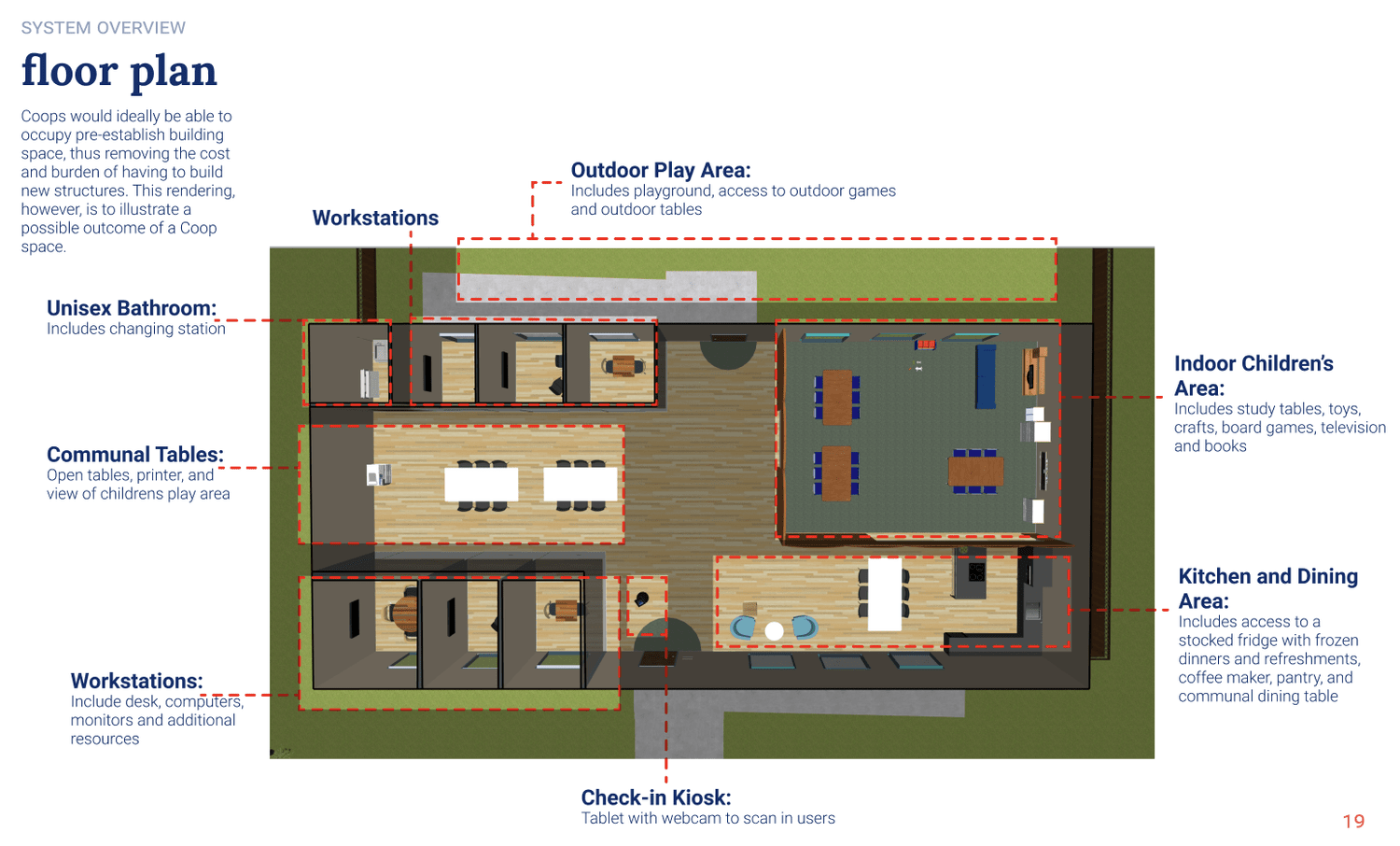
Standardized Floor Plan: This is the basic format, COOP can be modified to fit available community spaces
Phase 3: Conclusion
For future iterations, I would like to bring this out of the speculative realm and find a way for a program like this to live in the real world.
Families aren’t getting the support that they need and they need it today, not in the unforeseeable future.